Review a Job Rejection Without Inventing a Reason
A rejection gives an outcome, often with limited explanation. Review the evidence you have, choose a useful improvement and avoid treating silence or a template message as a complete diagnosis.
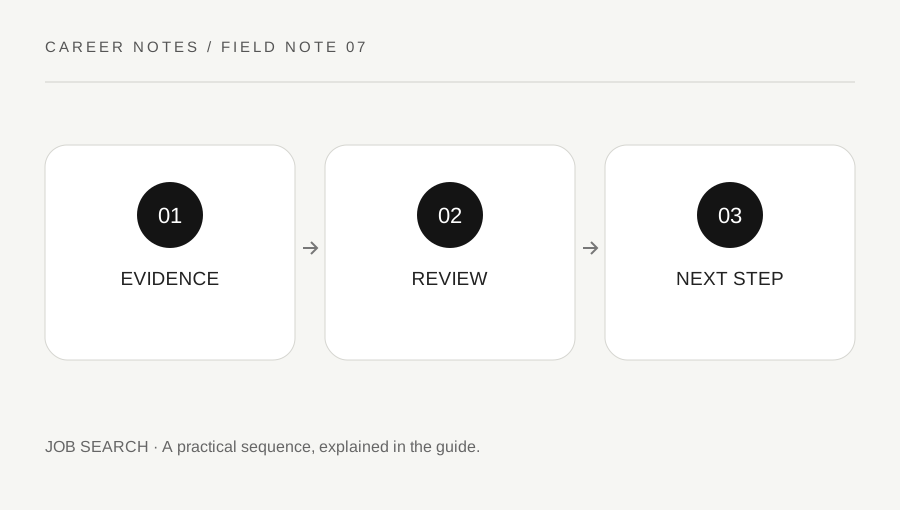
Original explanatory diagram. Examples illustrate a method or decision; they are not claims of personal testing.
Separate the outcome from the explanation
Record the stage reached and the actual communication received. A standard rejection may confirm that the process has ended without explaining why. Do not turn a lack of detail into certainty that one sentence, age, qualification or follow-up note caused the decision. Some questions remain unanswered, and acknowledging that is more accurate than filling the gap with a confident story.
Keep any specific feedback in its original wording and scope. An interviewer may comment on one example or exercise rather than your entire suitability for the profession. Distinguish a concrete observation from a broad opinion. If feedback is offered through the employer's process, ask a focused respectful question where appropriate, without demanding confidential information about other candidates.
Review the parts you can actually inspect
Compare your submitted documents with the vacancy and check whether the relevant evidence was easy to find. Review interview notes while they are still useful: which questions you understood, where an example became vague and what you would explain more clearly next time. Do not rewrite your entire history based on one application outcome.
Choose a small number of improvements that have a clear basis. You might practise a concise explanation of a genuine project, fix an application inconsistency or improve your preparation for a specific exercise. Keep unsupported assumptions out of the plan. A constructive review identifies an action you can take rather than trying to prove that every rejection has one simple personal cause.
Work through a limited-feedback example
Imagine a candidate receives feedback that their project example did not make their own contribution clear. They revisit the example, separate team activity from personal actions and practise a truthful concise account. They do not invent a larger role or add a numerical outcome they cannot verify. The improvement follows the feedback directly.
If the message contains no feedback, they can still inspect their documents and preparation, but should label any suspected issue as a hypothesis. A trusted adviser may help review the evidence without pretending to know the employer's private decision. This distinction allows learning while protecting the candidate from treating every uncertain detail as a confirmed failure.
Close the application and continue deliberately
Update the tracker so the application no longer sits as an unresolved task. Keep useful materials and remove private copies according to your needs. If you send a response or feedback request, use the authorized recruiting channel and keep it proportionate. Do not contact unrelated employees or repeatedly ask for a different outcome after the process is closed.
Return to roles that fit your evidence and preferences, using the specific improvement you chose. Build breaks and practical support into a sustained search rather than making every outcome a verdict on personal worth. This guide offers a review method, not a guarantee of the next result. A useful next step can be small, truthful and under your control even when the decision's full explanation remains unavailable.
Review a pattern only with comparable cases
If several applications stop at the same stage, compare similar roles and actual materials before drawing a broader conclusion. A mixed set of unrelated vacancies may not reveal a meaningful pattern. Note what changed and what stayed consistent, and ask a qualified careers adviser for help where useful. Do not manufacture a numerical success rate from a tiny or inconsistent set and treat it as a reliable forecast. The purpose of tracking is to guide a practical adjustment, not to create an absolute judgment about your prospects.
A practical checklist
Choices are saved in this browser. Reset them here or clear this site’s browser storage.
Questions that come up
Does a template rejection tell me why I was rejected?
Usually it supplies limited information. Do not infer a precise cause that the communication does not establish.
Should I change everything after one rejection?
Review relevant evidence and choose a proportionate improvement. One outcome rarely supports a complete diagnosis of the application process.
Can an adviser know the private decision?
They can help assess your materials and preparation, but should not claim knowledge of an employer’s undisclosed reasoning.
References & scope
Background references checked on 18 October 2026. Worked examples and diagrams are original teaching material.