Questions to Ask an Interviewer That Help You Understand the Job
The final questions are a chance to learn how the role actually works. Prepare a few specific questions, listen to what has already been answered and follow the conversation rather than reciting a script.
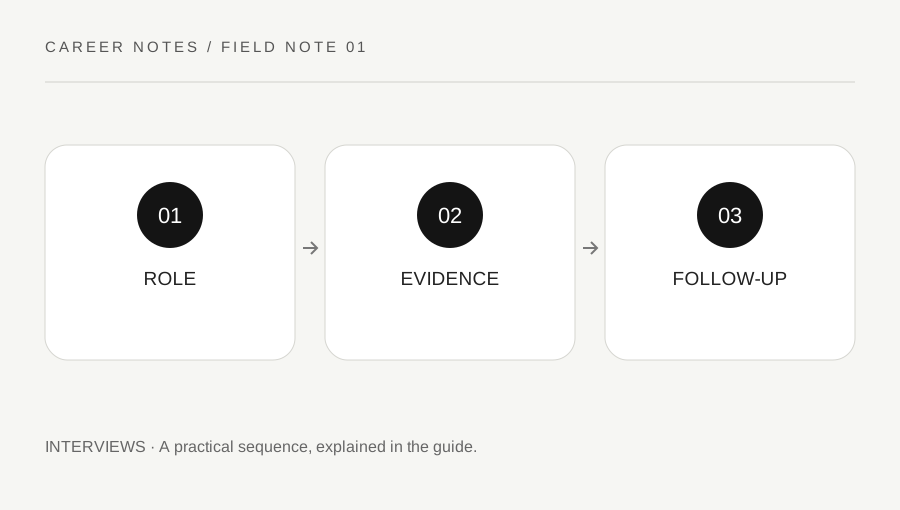
Original explanatory diagram. Examples illustrate a method or decision; they are not claims of personal testing.
Choose the uncertainty you need to resolve
Read the vacancy and your interview notes, then list what you still need to know about the work. Useful areas include the first priorities, how success is reviewed, the people you would work with and the support available while learning. Start from a real question rather than searching for a line that sounds impressive.
Separate factual gaps from preferences. You may need to confirm a working arrangement, while also wanting to understand how the team makes decisions. Ask at the appropriate stage and through the channel the employer provides. Do not assume every interviewer can answer every benefits or contractual question. A recruiter, hiring manager and future colleague may each have different useful information.
Ask for an example of ordinary work
A question about a typical project can reveal more than a broad request to describe the culture. Try asking what a successful first assignment might involve, how priorities are agreed or how the team handles a change in requirements. Keep the wording open enough to allow a real answer, and avoid packing five unrelated questions into one breath.
Listen for a concrete example and use a short follow-up where needed. If the answer says that priorities change often, you might ask how the team decides what to pause. This is a practical inquiry, not a challenge to prove the organization is perfect. You are gathering information that helps both sides understand whether the role and your expectations align.
Work through a candidate’s preparation
Imagine a coordinator candidate knows the advertised duties but not how requests arrive. They prepare: how are incoming requests prioritized, who reviews the first deliverable and what would you hope the new person can handle after the initial learning period? During the interview, the manager already explains the review process, so the candidate skips that question and asks about prioritization.
The manager gives a recent example of two competing deadlines. The candidate asks who makes the final tradeoff and notes the answer privately afterward. This demonstrates attention without requiring a rehearsed speech. The example is invented for teaching; it does not promise that a particular question will improve an interview score or produce an offer.
Keep a short list and close clearly
Prepare more questions than you expect to use, then choose the most useful ones for the time available. If the interviewer has already answered everything, acknowledge the information and ask a genuine clarification instead of repeating a question for appearances. Leave room for the employer to explain the next steps and expected communication route.
Afterward, record what you learned and what remains uncertain. Do not treat one vague answer as proof of a whole organizational culture, but do not ignore an important unanswered practical question either. If another stage is offered, carry the unresolved issue forward. A good question list supports an informed decision about the role, while your examples and conversation still need to establish your suitability for the work.
Avoid questions that require confidential information
Ask about a process or anonymized example rather than requesting private client details, another candidate's performance or internal material the interviewer cannot share. If an example is unavailable, a general explanation of responsibilities may still answer the practical question. Treat the interview as a professional conversation with limits. The aim is to understand the job sufficiently to assess it, not to collect information you would not be entitled to use outside the discussion.
A practical checklist
Choices are saved in this browser. Reset them here or clear this site’s browser storage.
Questions that come up
How many questions should I ask?
Use the time available for the most useful questions. A short relevant conversation is better than rushing through every prepared item.
What if the interviewer answered my list already?
Acknowledge that and ask a genuine clarification if needed. Do not repeat questions solely to perform a routine.
Can questions guarantee an offer?
No. They help you understand the role and participate thoughtfully, but no script guarantees a hiring outcome.
References & scope
Background references checked on 18 October 2026. Worked examples and diagrams are original teaching material.