Read a Job Description as an Evidence Map
Before adapting an application, identify what the role asks for and which real examples support your fit. Keep evidence, gaps and questions separate instead of copying every phrase into your CV.
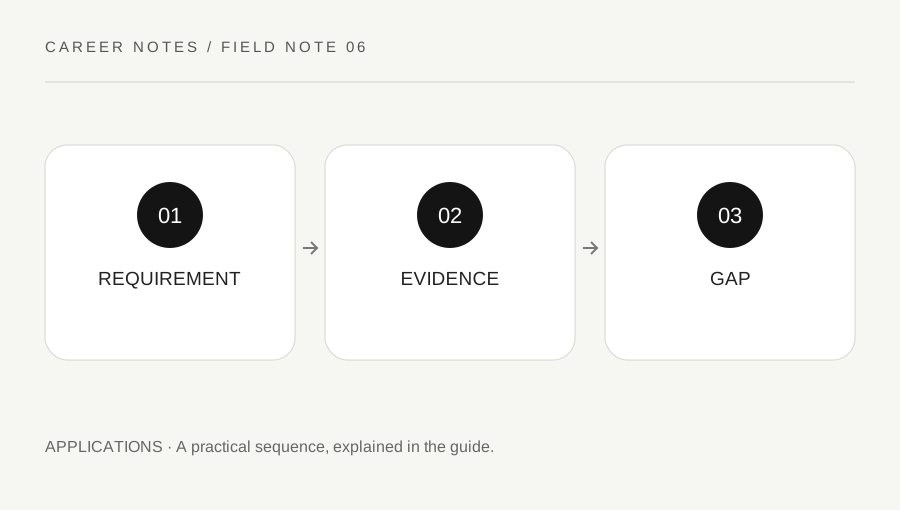
Original explanatory diagram. Examples illustrate a method or decision; they are not claims of personal testing.
Separate duties, requirements and context
Read the whole vacancy once, then mark the work the person will do, the stated requirements and the organizational context. Distinguish essential conditions from preferences where the employer labels them. Do not assume that every repeated word carries a hidden numerical score or that an automated system rewards a fixed keyword density.
Use a simple private table with a requirement in one column and a relevant real example in the next. Add a third column for a gap or a question. This makes it possible to decide whether the role is a plausible target before spending time on wording. Keep the original vacancy reference and date because the posting may change or disappear during the process.
Choose examples that demonstrate the requested work
For each important requirement, identify what you actually did, the setting and an outcome you can support. A statement that you are organized is less informative than a concise example of coordinating a real task. Be clear about your contribution within a team and avoid inflating a supporting role into leadership because the vacancy uses a stronger title.
Use the employer's terminology when it accurately describes your experience, but do not copy requirements as if they were already achievements. If your evidence comes from study, volunteering or another setting, label it honestly. Transfer can be explained through the work involved without pretending the contexts were identical. The application should make the connection easy to see while preserving the truth of the example.
Work through a fictional coordinator requirement
Imagine a vacancy asks for tracking deadlines across several contributors. An applicant has a genuine volunteer example: they maintained a shared schedule, checked missing inputs and flagged a conflict to the organizer. They can describe those actions and the completed event without claiming to have managed a professional department.
If the vacancy also asks for a system they have not used, they mark that gap rather than inserting its name as a skill. They may mention related genuine learning where appropriate and ask a focused question if the requirement is unclear. This evidence map supports an honest application and useful interview preparation; it is not a trick for bypassing the employer's actual needs.
Adapt the document and check consistency
Select the strongest relevant examples for the CV and cover letter rather than attempting to mention every item. Keep dates, titles and outcomes consistent across documents. If an application asks a specific question, answer that question directly with evidence instead of relying on a generic paragraph copied from another role.
Before submission, review the employer's instructions and required attachments. Do not claim qualifications, permissions or availability you do not have. Keep the private map for interview preparation, including gaps you may need to explain. A careful application makes the relevant connection visible and leaves unsupported requirements as honest questions or limitations, rather than hiding them in a dense list of borrowed phrases.
Use the map to decide where not to apply
A clear mismatch in a genuinely required qualification, availability or work condition may justify choosing another opportunity. The map is useful for selection as well as writing. If a requirement is ambiguous, seek clarification through the official recruiting route rather than assuming it is flexible or absolute. Keep your time and energy in view. A smaller number of well-matched truthful applications can be a more manageable process, although no application strategy guarantees a particular response or hiring result.
A practical checklist
Choices are saved in this browser. Reset them here or clear this site’s browser storage.
Questions that come up
Should I copy every keyword into my CV?
Use accurate relevant terminology, but do not turn requirements into unsupported claims or assume a fixed keyword formula guarantees success.
Can a volunteer example be relevant?
Yes, when it genuinely demonstrates the work and is clearly labelled with its actual context and contribution.
What if I do not meet one requirement?
Read whether it is essential, clarify genuine ambiguity and make an honest decision about the fit rather than claiming it anyway.
References & scope
Background references checked on 18 October 2026. Worked examples and diagrams are original teaching material.