Write a Useful Interview Follow-Up Note Without Repeating Your CV
A follow-up note can acknowledge the conversation and confirm interest. Keep it accurate, brief and aligned with the employer’s communication instructions rather than treating it as a second application.
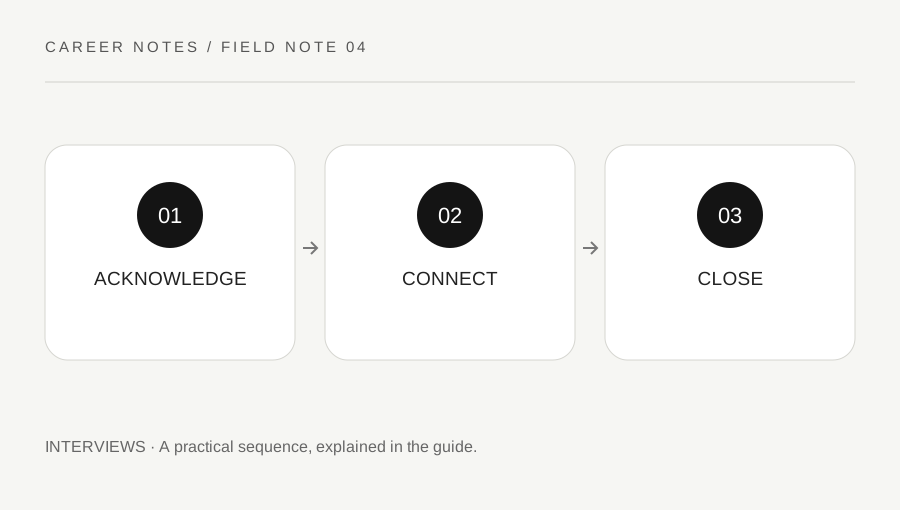
Original explanatory diagram. Examples illustrate a method or decision; they are not claims of personal testing.
Check the agreed communication route
Review the interview invitation and any next-step instructions before drafting. The employer may provide a recruiter contact or ask candidates to use a portal. Respect that route and any stated timeline. Do not search for private contact details or message multiple employees merely because the application process feels uncertain.
Separate a thank-you note from a status inquiry. A note after the conversation can acknowledge the time and a relevant point discussed. A later inquiry asks about progress when an appropriate interval or agreed date has passed. Combining repeated status requests with a thank-you can create pressure without adding useful information. Keep the purpose clear before choosing the wording.
Use one specific connection to the discussion
Thank the person for the conversation and mention a concrete aspect of the role you understood better. Connect that point to a genuine relevant experience or interest in one concise sentence. Do not introduce a new unsupported achievement or repeat the entire CV. A specific reference is useful only if it accurately reflects what was said.
Proofread names, role titles and any factual detail. If several people interviewed you, follow the appropriate route and avoid sending identical generic notes to every address you can find. You do not need an elaborate performance of enthusiasm. A clear professional message can be warm without exaggerating the relationship or claiming certainty about an offer.
Work through an illustrative draft
For a fictional coordinator role, a draft could thank the interviewer for explaining how requests are prioritized, note that the discussion reinforced the applicant's interest in organizing cross-team work and offer to supply any requested further information. The applicant would replace every detail with truthful content from their own conversation.
If they forgot to mention a relevant point, they can consider a short clarification where appropriate, but should not turn the follow-up into a long attempt to redo the interview. If a correction concerns a material factual mistake, state it plainly through the proper channel. Keep private client or employer information out of any example used to illustrate experience.
Send only after reviewing purpose and accuracy
Read the note once for facts and once for tone. Check recipient details and remove attachments that were not requested. Follow any recruitment instructions about additional documents. This guide helps you draft; it does not send messages or imply that a particular note guarantees an offer.
Record the contact date in your application tracker and return to the rest of your job search. If the employer gave a response window, use it to guide any later inquiry. Avoid repeated messages that ask the same unanswered question. A useful follow-up leaves a clear professional record and respects both your interest and the employer's process, while hiring decisions still depend on factors beyond the note.
Treat silence as incomplete information
No reply to a thank-you message does not establish rejection, acceptance or a judgment about its wording. Recruiting teams differ in how they acknowledge messages. Use explicit process updates and the agreed timeline as stronger evidence. If a later status inquiry is appropriate, make it a separate concise message through the official route. Do not keep rewriting the earlier note in your head as if it controlled the entire outcome; focus on concrete next steps you can actually take.
A practical checklist
Choices are saved in this browser. Reset them here or clear this site’s browser storage.
Questions that come up
Can a perfect follow-up guarantee an offer?
No. It is a professional communication, not a hiring guarantee. Keep it useful and proportionate.
Should I chase a reply to the thank-you?
Use the employer’s stated process and timeline. A lack of acknowledgement alone does not reveal the decision.
Can I clarify a factual mistake?
Where appropriate, make a concise accurate correction through the proper channel rather than turning the note into a second interview.
References & scope
Background references checked on 18 October 2026. Worked examples and diagrams are original teaching material.