Plan the First Week of a New Role Around Questions and Small Deliverables
A first-week plan should help you learn how work is done before making large promises. Confirm priorities, access and review routes with the people responsible for the role.
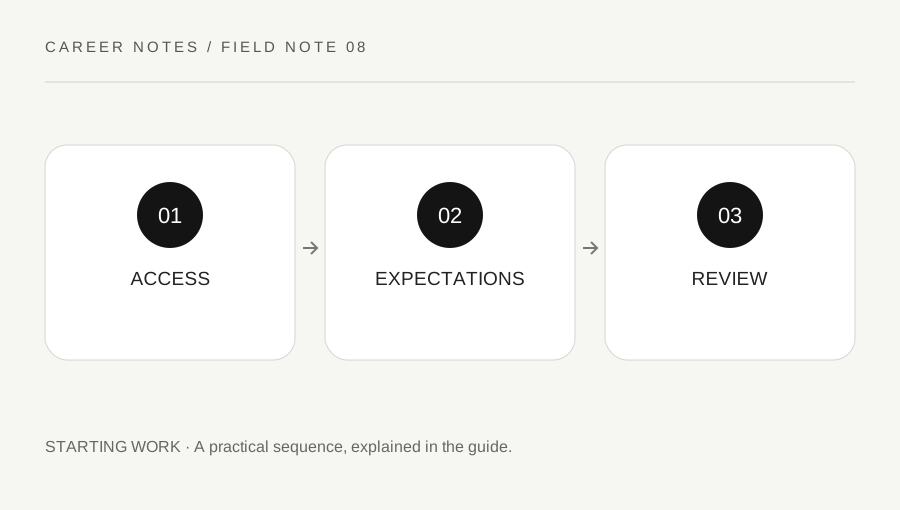
Original explanatory diagram. Examples illustrate a method or decision; they are not claims of personal testing.
Ask for the immediate priorities
Use the manager's onboarding instructions as the starting point. Clarify what needs attention first, what can wait and which activities are for learning rather than independent delivery. Avoid assuming the vacancy description is a complete daily schedule. The actual team may have current priorities or dependencies that were not visible during recruitment.
Keep a short list of questions grouped by topic so you can use other people's time well. Ask who handles each area rather than sending every question to the busiest person. Record answers in an approved private workspace. Do not copy internal material to a personal service merely to make your notes more convenient, and follow the organization's access and information-handling rules.
Confirm tools, people and review routes
Check that you can reach the systems required for the first tasks through the official process. Report missing access rather than borrowing another person's credentials or trying to bypass controls. Learn where source files, current instructions and completed work belong. A clean access record prevents a simple setup gap from looking like a performance problem.
Ask how work is reviewed and how to raise uncertainty. Identify the person who approves a deliverable, the expected format and any examples you are allowed to use. Notice who supplies inputs and who receives the output. This practical map is more useful than memorizing every organizational title without understanding how a task moves between people.
Work through a small deliverable example
Imagine a new coordinator is asked to prepare a weekly status summary. They first confirm the audience, the approved source of updates and the person who reviews the draft. They produce a small sample using authorized information and ask whether the level of detail is useful before building the full recurring routine.
If an input is missing, they flag it clearly rather than inventing a status. They keep unknown, pending and complete distinct. This example shows a learning-oriented first task, not a universal onboarding timetable. A role with safety, professional or regulated requirements may have formal training and authorization gates that take priority over any general productivity plan.
Review the week without making premature promises
At an appropriate check-in, summarize what you learned, what you completed and what remains blocked. Ask which next task deserves priority. Be specific about support or access you need, and avoid presenting a temporary workaround as the permanent process without approval. Record any agreed follow-up so both sides have a clear next step.
Keep the plan adaptable to the role and your circumstances. You do not need to redesign every workflow during the first week to show interest. Listening, accurate small outputs and timely questions can provide a stronger foundation than unsupported promises of rapid transformation. The useful outcome is a clearer shared understanding of the work and a verified route to completing the next task.
Keep a glossary of actual team terms
Write unfamiliar abbreviations with a plain explanation and the source of the answer. Teams often use the same word for different tools, files or review stages, so ask when a term affects a task. Do not guess and repeat the guess as established knowledge. A concise approved glossary can reduce repeated questions and make your notes easier to revisit. Keep confidential project names and internal definitions inside the organization's permitted environment rather than publishing them as part of a personal onboarding story.
A practical checklist
Choices are saved in this browser. Reset them here or clear this site’s browser storage.
Questions that come up
Should I propose a complete redesign immediately?
First understand the work, constraints and decision route. A small verified contribution can be more useful than a broad premature promise.
Can I borrow a colleague’s login while waiting?
Use the official access process and report the blocker. Do not bypass controls or share credentials.
Is this a fixed schedule for every profession?
No. Formal training, safety and authorization requirements take priority where they apply.
References & scope
Background references checked on 18 October 2026. Worked examples and diagrams are original teaching material.